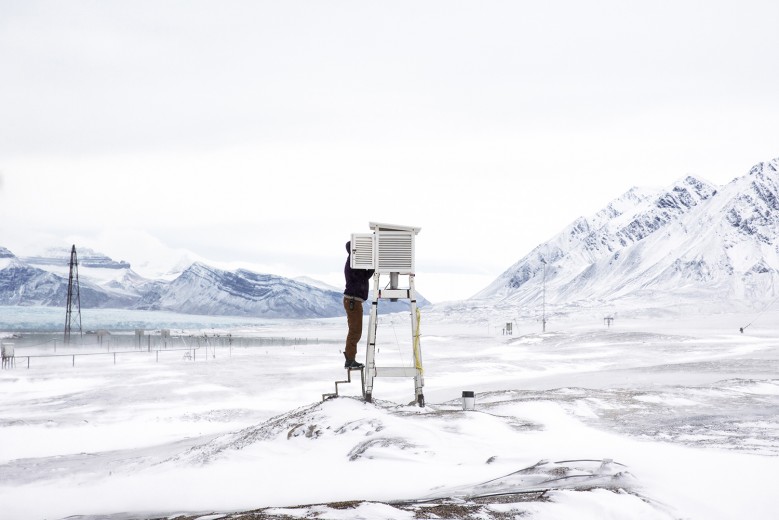
In February 2012 I went to North Greenland to make an overland journey
of a couple of hundred kilometers by dog sled. I wanted to find the
North. My first impression was of the otherworldliness of the place: a
coastline with nothing to see but bare ancient rock; glaciers touching
the horizon; and icebergs looking like cathedrals. A dry polar desert
with ubiquitous rocks, an infinite frozen ocean and lack of
vegetation.
The Arctic is constantly moving and shifting, melting reforming,
appearing and disappearing. The weather changes, erases, creates or
simply hides the land. Even Magnetic North shifts constantly. It
eludes GPS, the compass and paper maps.
The Arctic region produces an abiding sense of dislocation in those
who go there. Here rocks, ice and ocean gradually give way to a
progressive whiteness. What happens to our senses when we lose
ourselves in a land where we cannot see boundaries or outlines? When
do we lose a sense of scale? What happens when the maps are useless?
What can we rely on?
Perhaps different kinds of maps are needed. Greenland’s rocks, some of
the oldest on the planet, are the memory
of the land. The fractures of the ice and glaciers read like charts of
climactic events.
To travel north is to voyage off the map. In these vast voids, the
traveler turns inwards on an imaginary journey. One starts to imagine
what could be there as well as what is.
The focus of this project was to create images of the geothermal industrial landscape and to show the co-existence of industry and nature.
Icelanders are world leaders in the use of geothermal energy for domestic and industrial purposes. It makes up 66% of the country's primary energy usage. This pioneering use of natural energy sources has made theirs one of the cleanest environments in the world.
Iceland is one of the most tectonically active places on Earth, resulting in a large number of volcanoes and hot springs serving as infinite and sustainable energy sources.
Though geothermal energy provides a cleaner choice for energy production, it transforms the otherwise wild landscape into one of development and human dominance.
The extraction of geothermal energy is transforming the rural landscape. In this way, nature is shaped by industry. This project documents this transformation and tries to show the grace and beauty within these new artificial landscapes.
Due to it's remote location and freezing temperatures, greenhouse growing is the only way to yield good quality produce in Iceland.
Artificial light is required to supplement the shorter daylight hours at these northern latitudes and to create enough heat to grow different types of vegetables (tomatoes, cucumbers), flowers and fruits such as bananas.
It is fascinating how only one thin layer of glass divides the cold and dark world outside from the warmth and light inside. The environment is at once tropical and arctic; light and darkness against warmth and freezing coldness.
Inside the greenhouses there is another world. One can smell the soil, feel the humidity, hear the sounds of insects and the rush of steam, whilst the freezing wind blows outside.
To the human eye, the Arctic landscape appears frozen in time. But
this environment is actually changing and one can see the landscape
disappear … The Arctic is the most sensitive place on the planet to
measure climate change as it is made largely of ice.